This section supplements the “LIS-SV”
product manual. The parameters described here are only available if the LIS-SV
is used in an ABULiner control unit.
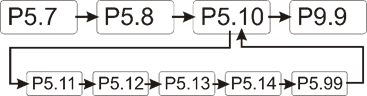
Overview of the
'ABULiner' parameter level
The following parameters can be set in the 'ABULiner'
parameter level of the LIS-SV.
|

|
Danger during setting work!
During setting work on the LIS-SV, monitoring of
the wire rope hoist is switched off. This means the wire rope hoist cannot
be monitored for excess load, among other things. This means the
wire rope hoist cannot be monitored for excess load, among other
things.
This in turn means the load could fall and kill or
injure people!
Do not use the crane for normal work during
setting work, and only lift loads very carefully for test
purposes! |
All LIS-SV parameters which are important for the ABULiner
are combined in a separate parameter level, which is shown as a submenu.
 Move the load hook out of
the limit switch range (up or down).
Move the load hook out of
the limit switch range (up or down).
During parameter setting, the load hook must not be within the
limit switch range.
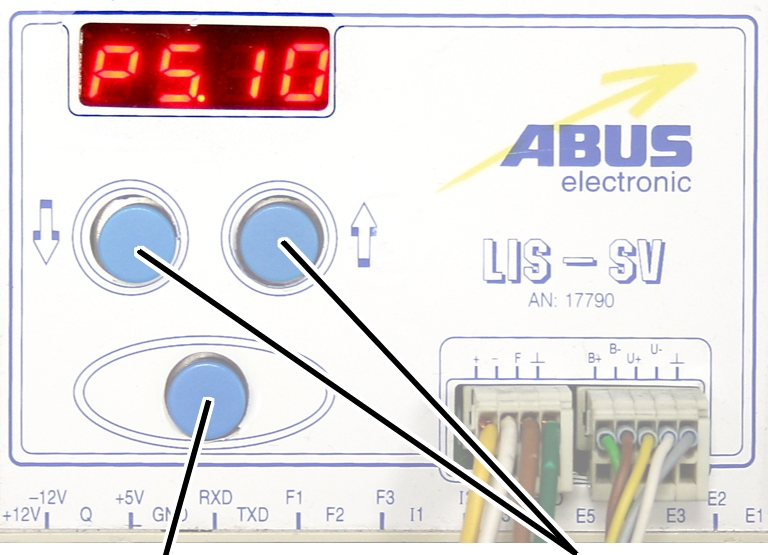
Open the menu of the
LIS-SV. See the documentation “Load indicator system LIS-SV”.
|
|
|
Enter
button |
Arrow
buttons |
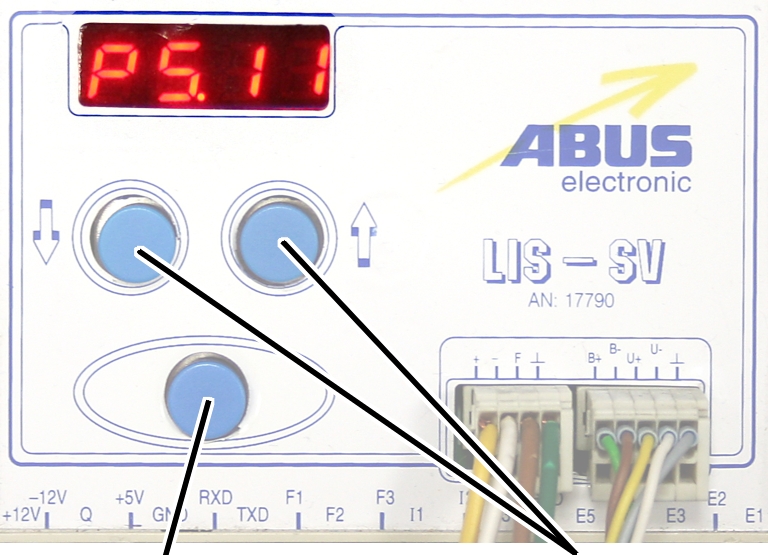
 Select parameter 5.10.
Press ENTER.
● The
'ABULiner' parameter level is activated.
● Parameter
5.11 is displayed.
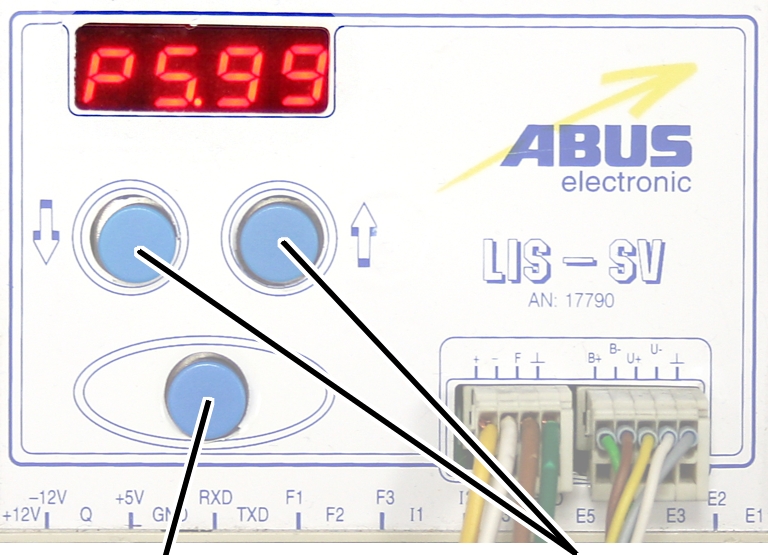
Exiting the
'ABULiner' parameter level
|
|
|
Enter
button |
Arrow
buttons |
Select parameter 5.99.
Press ENTER.
● The
previous parameter level is reactivated.
● Parameter
5.10 is displayed.
The LIS-SV is automatically activated for the ABULiner if a
value is entered for the parameter 5.11.
In the ABULiner mode (a value is set for parameter 5.11):
─ The
LIS-SV can monitor the total load for a maximum of two wire rope hoists.
─ Input F3
(normally used for measuring the load of wire rope hoist 3) now serves in
monitoring the current rotational frequency of the hoist motor.
─ A value
can be entered for parameter 3.0 (maximum load capacity of wire rope hoist 3).
If a value is entered for this, parameter 5.11 cannot be set.
─ This
interlocking thus excludes an incorrect setting.
─ The
load-controlled switching point at output TxD of the LIS-SV cannot be used.
─
Parameter 4.5 (setting for load-controlled switching point) is not available.
In the normal mode (no value is set for parameter 5.11):
─
Operation of the ABULiner Lifting/Lowering unit is not possible.
─ The
LIS-SV can monitor the total load for up to three wire rope hoists.
─ Input F3
serves in measuring the load of a third wire rope hoist.
─ A value
can be entered for parameter 5.11 (gear ratio). If a value is entered for this,
parameter 3.0 cannot be set.
─ This
interlocking thus excludes an incorrect setting.
─ The
load-controlled switching point at output TxD of the LIS-SV can be used.
─
Parameter 4.5 (setting for load-controlled switching point) can be used.
The LIS-SV uses the signal of the encoder and the gear ratio
of the hoisting gear to calculate the hook travel distance, the maximum distance
in the limit switch range and the current rotational frequency of the hoist
motor. The gear ratio must be set on the machine.
|
|
|
Cable
speed |
|
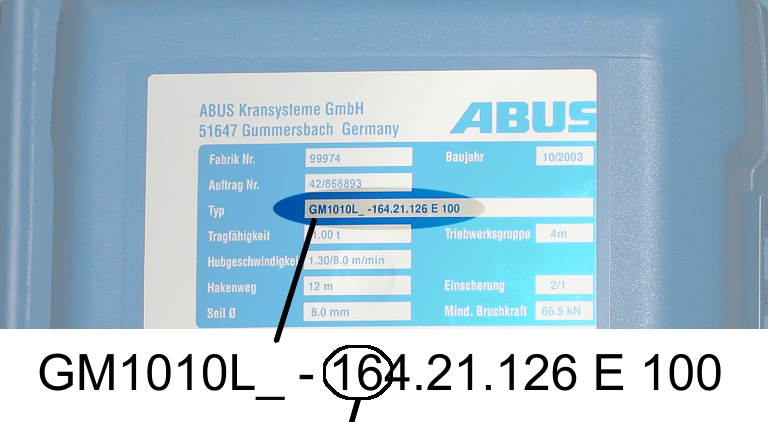
Read off the type
designation at the type plate of the wire rope hoist.
Read off the cable
speed.
From this table, select
the gear ratio that matches the cable speed.
|
|
Cable
speed |
|
Hoist motor GM |
32 m/min at 50 Hz
38 m/min at 60
Hz |
25 m/min at 50 Hz
30 m/min at 60
Hz |
20 m/min at 50 Hz
24 m/min at 60
Hz |
16 m/min at 50 Hz
19 m/min at 60
Hz |
|
800.4 |
50.01 |
63.49 |
77.77 |
98.16 |
|
800.5 |
47.03 |
60.04 |
74.66 |
95.03 |
|
1000.6 |
54.43 |
68.91 |
84.00 |
105.1 |
|
1000.7 |
54.60 |
68.06 |
81.45 |
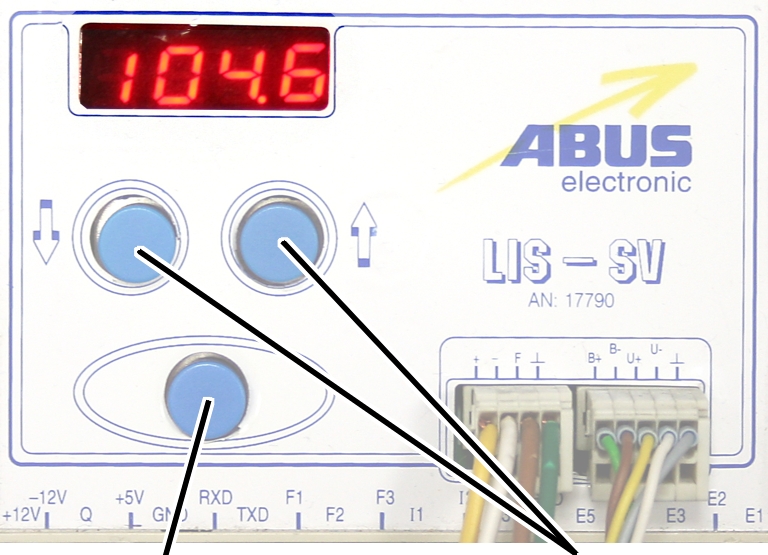
104.6 |
|
2000.3 |
58.22 |
74.23 |
91.19 |
118.4 |
|
3000.4 |
73.61 |
93.92 |
118.4 |
152.9 |
|
5000.3 |
85.14 |
109.3 |
132.8 |
169.0 |
|
5000.4 |
80.20 |
104.9 |
127.7 |
160.6 |
|
6000.3 |
94.69 |
118.5 |
149.6 |
182.7 |
|
7000.1 |
118.0 |
148.3 |
182.6 |
232.0 |
|
|
|
|
|
|
Table: Gear ratios (numerical values) depending on
hoist motor (lines) and cable speeds (columns) at 50 and 60 Hz.
|
|
|
Enter
button |
Arrow
buttons |
Move the load hook out of
the limit switch range (up or down).
During parameter setting, the load hook must not be within the
limit switch range.
Select parameter 5.11.
Press ENTER.
● The set
value is displayed.
If the value is 0.00, the function is deactivated.
● Hold ENTER
pressed.
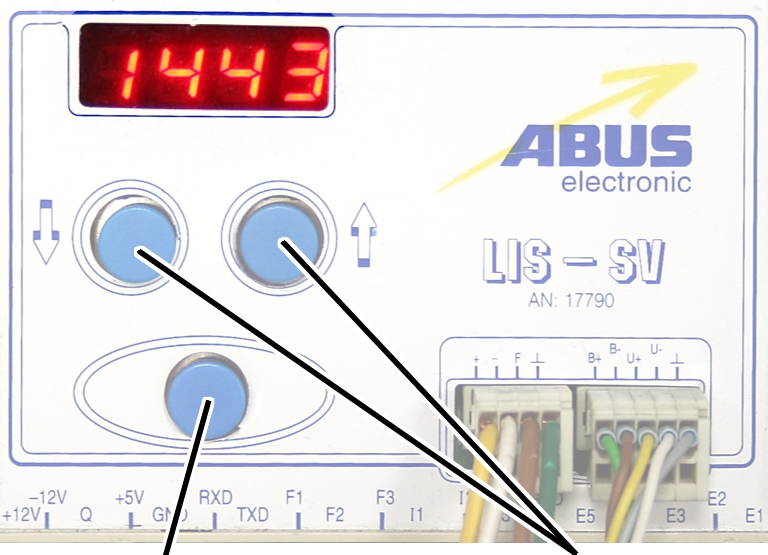
● CODE is
displayed.
Hold ENTER pressed.
|
|
|
Enter
button |
Arrow
buttons |
Enter the code 1443.
Press ENTER briefly.
|
|
|
Enter
button |
Arrow
buttons |
Set the value from the
table.
If the display ‘0.00’ cannot be changed, a value is set in
parameter 3.0. In this case, set the value to zero first.
Press ENTER briefly.
Shemale Maa Se Beti Ki Chudai Kahani Extra Quality Jun 2026
The transgender community and LGBTQ+ culture share an intertwined history shaped by resistance, celebration, and a continuous fight for human rights. While the broader LGBTQ+ acronym brings together diverse sexual orientations and gender identities, the transgender experience offers a unique perspective on gender presentation and bodily autonomy. Understanding this relationship requires exploring historical roots, modern cultural contributions, intersectional challenges, and the ongoing movement for global equality. The Historical Foundations of a Shared Movement
This has created a new solidarity. Gay men and lesbians who already won their marriage rights are now marching again for trans healthcare. Bisexual and queer organizations are funding trans mutual aid networks. The reason is simple: the legal precedent used to ban trans healthcare (e.g., Dobbs v. Jackson and the logic of bodily autonomy) could be used to overturn gay rights next.
Conversely, the trans community must continue to recognize that its struggles, while unique, are part of a larger tapestry. The fight for trans liberation is the fight for queer liberation. The same forces that want to criminalize gender-affirming care also want to overturn Obergefell v. Hodges (marriage equality). The same hatred that kills trans women of color also drives the violence against gay men. shemale maa se beti ki chudai kahani extra quality
This tension has given rise to a rift. On one side, you have organizations like the or RadFems (Radical Feminists) who argue that lesbian spaces must be based on "female socialization" or biological sex. On the other side, the mainstream LGBTQ culture argues that trans women are women , and excluding them is a betrayal of the history of Stonewall.
The shared history of oppression has created a distinct culture of resilience within the LGBTQ community. This resilience is visible in community-building, activism, and the celebration of diversity, individuality, and sexuality. 3. The Role of Transgender People in LGBTQ Culture The transgender community and LGBTQ+ culture share an
The evolution of LGBTQ+ culture is inseparable from the history and resilience of the transgender community. By honoring past pioneers, protecting vulnerable members, and celebrating authentic self-expression, the collective movement moves closer to a world where everyone can live safely and openly. To help tailor more specific content on this topic, please
The transgender community has gifted the wider LGBTQ culture—and the world—a new vocabulary for the human experience. Terms like "cisgender" (someone whose gender identity aligns with their birth sex), "non-binary" (identifying outside the male/female binary), and "gender dysphoria" (distress caused by a mismatch between gender identity and birth sex) allow for nuanced discussions about identity. This language has moved beyond queer spaces into corporate HR departments, medical schools, and legislative chambers, fundamentally changing how society talks about personhood. The Historical Foundations of a Shared Movement This
: People whose gender identity aligns with the sex they were assigned at birth.
Understanding the and LGBTQ+ culture requires looking at both their shared history of advocacy and the unique experiences that define trans identity. The Power of Shared Identity and Culture
Only for auxiliary fans
The auxiliary fan of the hoist motor continues to run for
several minutes after the lifting or lowering. This ensures that the hoist motor
is adequately cooled even at slow lifting speeds. The run-on time can be
adjusted.
|
|
|
Enter
button |
Arrow
buttons |
Move the load hook out of
the limit switch range (up or down).
During parameter setting, the load hook must not be within the
limit switch range.
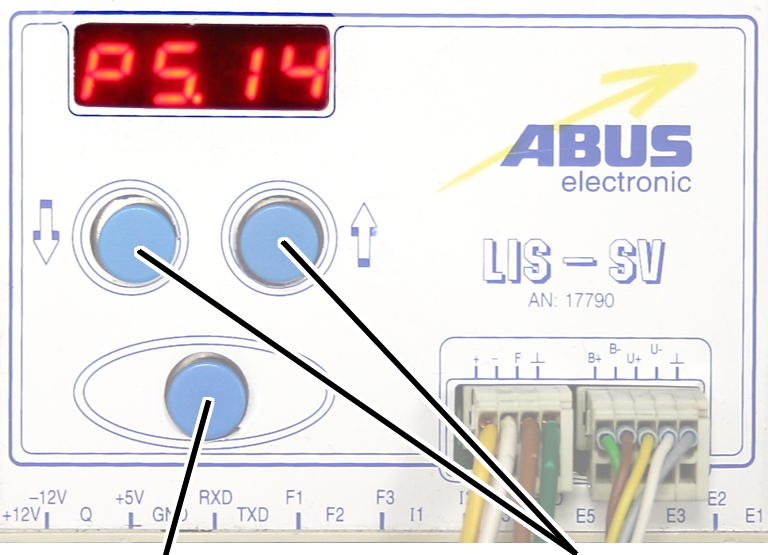
Select parameter 5.14.
Press ENTER.
● The set
value is displayed.
|
|
|
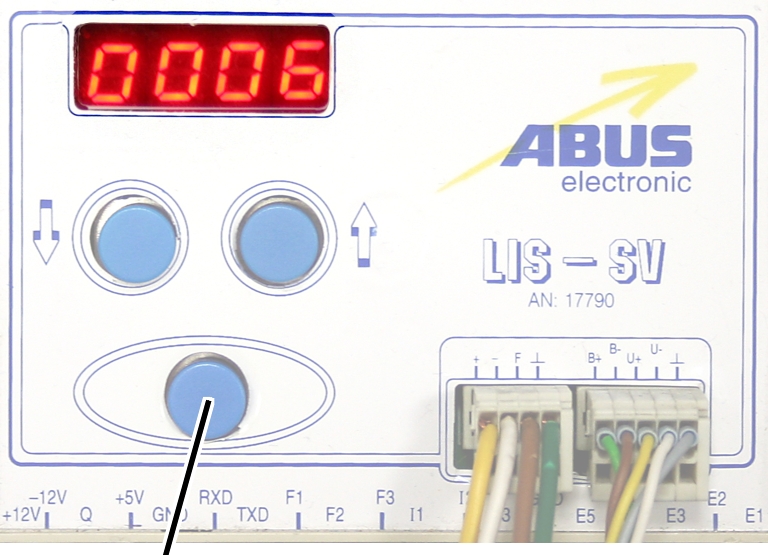
Enter
button |
|
Set the value to between 3
and 10 minutes using the arrow buttons.
Press ENTER.