killergram hard play karma lucia love
killergram hard play karma lucia love killergram hard play karma lucia love
killergram hard play karma lucia love
  Home
killergram hard play karma lucia love
  About Us
killergram hard play karma lucia love
  Products
killergram hard play karma lucia love
  Process Models
killergram hard play karma lucia love
  SE Resources
killergram hard play karma lucia love
  Commentary
killergram hard play karma lucia love
  Contact us
killergram hard play karma lucia love
Breaking News!

A new blog ...

Killergram Hard Play Karma Lucia Love ((new)) File

approached, his presence a silent reminder that in this game, every action invited an equal and opposite reaction.

Another keyword often associated with killergram is "karma." In many Eastern cultures, karma refers to the idea that an individual's actions have consequences, which can affect their future existence or experiences. In the context of killergram, the concept of karma may suggest that those who engage in malicious or hurtful behavior will ultimately face repercussions or come to harm.

The warehouse doors locked. Roman stopped crying. He stood up, wiped his face, and smiled at Lucia. "Paid actor," he said. "Your sister’s idea."

The phrase is the most enigmatic part of the keyword. Direct searches for a specific "Hard Play" series on Killergram's website or in public records do not yield a direct match. killergram hard play karma lucia love

The term "killergram" is often associated with a type of online message or post that is designed to provoke a strong reaction, often with the intention of "killing" or dominating a conversation or relationship. A killergram can take many forms, including a provocative statement, a clever insult, or a strategically crafted message meant to elicit a specific response. The goal of a killergram is often to gain power or control over a conversation or interaction, sometimes at the expense of others.

The film's aesthetic is designed to resemble a nightclub setting, utilizing specific lighting and costumes to create a distinct visual style. Karma Hard Play (Video 2014) - Full cast & crew

Karma is a complex, multifaceted individual with a flair for the dramatic. She exudes a confident, almost arrogant air, but beneath this façade lies a deeply sensitive and passionate soul. Karma has a strong sense of justice, though her methods of achieving it are often morally ambiguous. She's fiercely loyal to those she cares about, willing to go to great lengths to protect and support them. approached, his presence a silent reminder that in

Whether in digital marketing, personal branding, or social interaction, it’s about making a strong statement.

Her niche was "ethical annihilation." She’d hunt down online predators, abusive exes, and corrupt minor celebs, then broadcast their takedowns in real time. The chat exploded with skull emojis and heart hands. They called it hard play —part vigilante justice, part snuff theater. Lucia told herself the ends justified the screams.

: Karma: Hard Play (alternatively listed as Killergram’s Karma ). Release Year : 2014. Studio : Killergram / Pornostatic. The warehouse doors locked

However, the concept of karma can also be problematic, as it can create a culture of performative altruism or virtue signaling. Online individuals may prioritize appearances over actual positive actions, or engage in behaviors that are intended to generate karma rather than genuinely help others.

If you want to explore the underlying technologies or structural design of these platform types further,

In the context of "killergram hard play karma lucia love," it's possible to see the themes of intensity, karma, and love as intertwined. By acknowledging the complexities of relationships and the risks of toxic interactions, we can strive to create healthier, more balanced connections with others.


 
The newest edition!
killergram hard play karma lucia love Just Released!
Another
novel by
Roger Pressman!
killergram hard play karma lucia love
Now available from McGraw-Hill!
Available in trade paperback and e-book editions. For more information, click here.

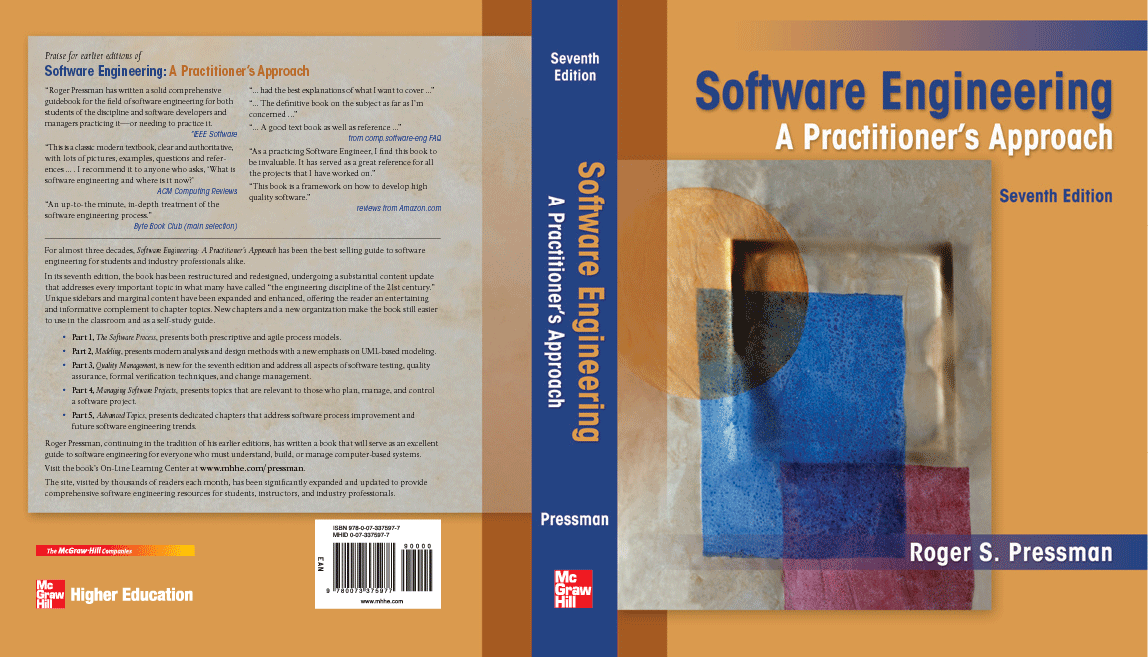
The seventh edition of Software Engineering: A Practitioner's Approach is intended to serve as a guide to a maturing engineering discipline. The seventh edition, like the six editions that preceded it, is intended for both students and practitioners, retaining its appeal as a guide to the industry professional and a comprehensive introduction to the student at the upper level undergraduate or first year graduate level.

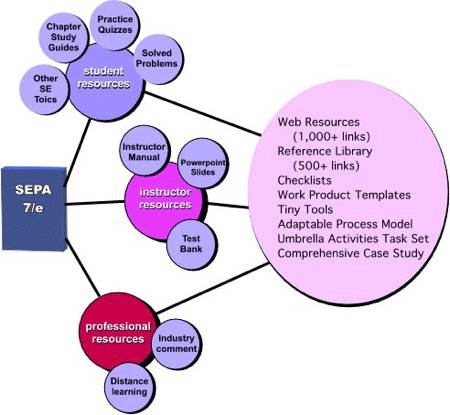
The seventh edition is considerably more than a simple update. The book has been revised and restructured to improve pedagogical flow and emphasize new and important software engineering processes and practices. In addition, a revised and updated “support system,” illustrated below, provides a comprehensive set of student, instructor, and professional resources to complement the content of the book.

killergram hard play karma lucia love
The 32 chapters of the seventh edition have been reorganized into five parts. This organization, which differs considerably from the sixth edition, has been done to better compartmentalize topics and assist instructors who may not have the time to complete the entire book in one term.

Part 1, The Process, presents a variety of different views of software process, considering all important process models and addressing the debate between prescriptive and agile process philosophies. Part 2, Modeling, presents analysis and design methods with an emphasis on object-oriented techniques and UML modeling. Pattern-based design and design for Web applications are also considered. Part 3, Quality Management, presents the concepts, procedures, techniques, and methods that enable a software team to assess software quality, review software engineering work products, conduct SQA procedures, and apply an effective testing strategy and tactics. In addition, formal modeling and verification methods are also considered. Part 4, Managing Software Projects, presents topics that are relevant to those who plan, manage, and control a software development project. Part 5, Advanced Topics, considers software process improvement and software engineering trends. Continuing in the tradition of past editions, a series of sidebars is used throughout the book to present the trials and tribulations of a (fictional) software team and to provide supplementary materials about methods and tools that are relevant to chapter topics. Two new appendices provide brief tutorials on UML and object-oriented thinking for those who may be unfamiliar with these important topics.

The five-part organization of the seventh edition enables an instructor to "cluster" topics based on available time and student need. An entire one-term course can be built around one or more of the five parts. A software engineering survey course would select chapters from all five parts. A software engineering course that emphasizes analysis and design would select topics from Parts 1 and 2. A testing-oriented software engineering course would select topics from Parts 1 and 3, with a brief foray into Part 2. A "management course" would stress Parts 1 and 4. By organizing the seventh edition in this way, I have attempted to provide an instructor with a number of teaching options.
Software Engineering: A Practitioner's Approach
7th Edition
Table of Contents

Chapters

1. Software and Software Engineering

Part I - Process

2. Process Models
3. Agile Development

Part II - Modeling

4. Practice: A Generic View
5. Understanding Requirements (new chapter)
6. Requirements Modeling: Scenarios and Data (new chapter)
7. Requirements Modeling: Flow, Classes, and Behavior (new chapter)
8. Design Concepts (new chapter)
9. Architectural Design
10. Component-Level Design
11. Usability design (new chapter)
12. Pattern-based Design (new chapter)
13. WebApp Design

Part III - Quality Management

14. Quality Concepts (new chapter)
15. Software reviews (new chapter)
16. Software Quality Assurance
17. Software Testing Strategies
18. Testing Methods for Conventional Software (new chapter)
19. Testing Methods for OO Software (new chapter)
20. Testing Methods for WebApps
21. Advanced Verification Methods (new chapter)
22. Software Configuration Management
23. Product Metrics

Part IV - Project Management

24. Management Concepts
25. Process and Project Metrics
26. Estimation
27. Scheduling
28. Risk Management
29. Maintenance and Reengineering (new chapter)

Part V-Advanced Topics

30. Software Process improvement (new chapter)
31. Emerging Trends in Software Engineering (new chapter)
32. The Road Ahead
Appendix I - UML Tutorial (new)
Appendix II - OO Concepts (new)


Home About us Products Product Models SE Resources Commentary Contact us
Web site and all contents © 2001-2009, R.S. Pressman & Associates, Inc., All rights reserved.
Free website templates